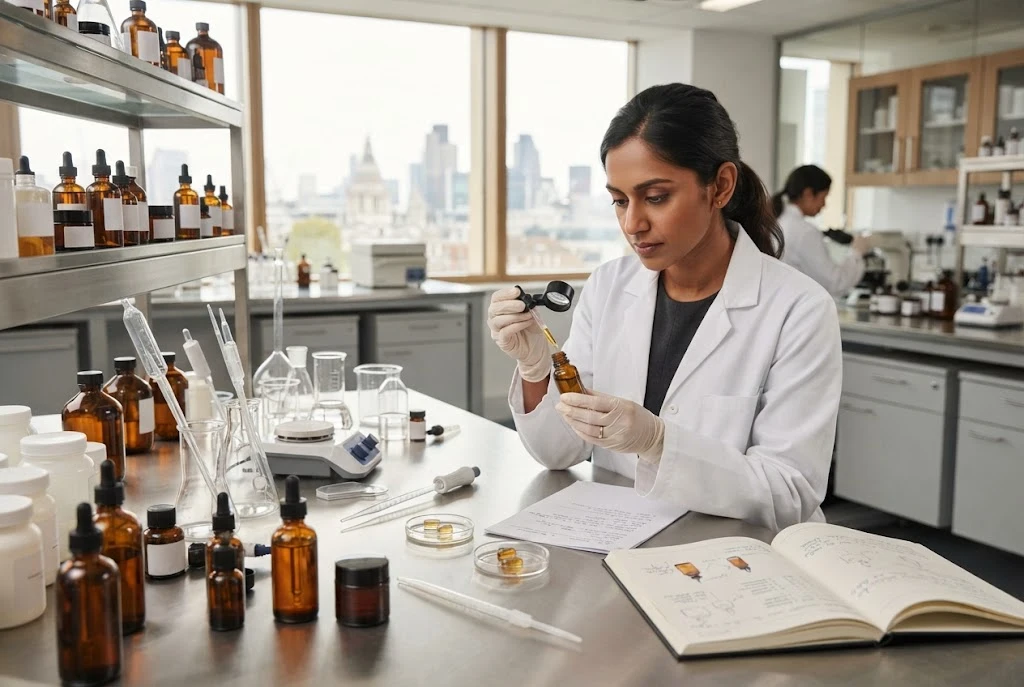
Beauty research has become increasingly important as consumers encounter more skincare ingredients, cosmetic technologies and product claims than ever before. A serum can promise brighter skin, a cream can claim to reduce visible signs of ageing, and a new ingredient can suddenly become a social media sensation. However, understanding whether these claims are supported by meaningful evidence requires more than reading a product label or watching a viral video.
Modern beauty science brings together dermatology, chemistry, formulation science, clinical research and consumer behaviour. For anyone interested in skincare, cosmetics or emerging beauty technology, learning how evidence is generated can make it easier to distinguish promising developments from marketing hype.
What Does Beauty Research Actually Mean?
Beauty research covers a wide range of scientific and consumer-focused work related to cosmetics, skincare, haircare and personal appearance. It can include laboratory studies, ingredient research, clinical trials, safety assessments, formulation testing, consumer studies and research into how people perceive beauty.
These different forms of research answer different questions. Laboratory research may investigate how an ingredient behaves at a cellular or chemical level. A clinical study can examine whether a finished product produces measurable changes in people. Consumer research may explore whether users notice a difference or find a product comfortable and convenient.
That distinction matters because evidence from one type of study does not automatically prove the same outcome in another setting.
Why Beauty Research Matters for Skincare
Skincare has become increasingly sophisticated. Products may contain multiple active ingredients, delivery systems and combinations designed to address specific concerns. As formulas become more complex, consumers need reliable information to understand what those ingredients are actually capable of doing.
A 2025 Delphi consensus study involving cosmetic dermatologists examined commonly recommended topical ingredients for concerns including acne, dark spots, redness, dry skin, oily skin and signs of ageing. The researchers identified consensus around ingredients including azelaic acid, benzoyl peroxide, glycolic acid, niacinamide, retinoids, salicylic acid and vitamin C, while also noting that the strength of evidence varied between ingredients. :contentReference[oaicite:0]{index=0}
This illustrates an important principle: a beauty ingredient should not be judged simply by how popular it is. Researchers consider the available evidence, the intended use, formulation and specific skin concern.
Skincare Research: From Ingredient to Finished Product
One of the biggest misunderstandings about skincare research is assuming that evidence for an individual ingredient automatically proves that every product containing it will deliver the same result.
In reality, formulation matters. The concentration of an ingredient, its stability, the product’s delivery system, the other ingredients in the formula and how frequently it is used can all influence performance.
For example, an ingredient may demonstrate interesting activity in laboratory research but have limited clinical evidence in a finished cosmetic product. A review of popular over-the-counter cosmeceutical ingredients has highlighted this difference, noting that some cosmetic ingredients have substantial clinical support while others rely more heavily on molecular or laboratory evidence. :contentReference[oaicite:1]{index=1}
Therefore, strong skincare research should be interpreted in context rather than reduced to a simple statement such as “ingredient X works”.
Laboratory evidence versus clinical evidence
Laboratory studies can be valuable during the early stages of cosmetic ingredient research. Researchers may investigate biological pathways, antioxidant behaviour, antimicrobial activity or interactions with particular cells.
However, laboratory findings do not necessarily predict what happens when a cosmetic product is applied to human skin under normal conditions.
Clinical research provides another level of evidence because it evaluates products or ingredients in people. The quality of that evidence still depends on study design, participant numbers, controls, duration and the outcomes being measured.
Beauty Clinical Studies and Evidence Quality
Clinical studies can provide useful information about whether a cosmetic intervention produces measurable changes. Yet not all studies carry the same evidential weight.
Randomised controlled trials can be particularly valuable because they are designed to reduce certain forms of bias. Control groups, comparison treatments and predefined outcomes can help researchers determine whether observed changes are likely to be associated with the intervention.
Recent dermatology research also demonstrates why the basic skincare routine should not be overlooked. A 2026 review examining placebo-controlled dermatology trials found that vehicle treatments — essentially the non-active bases used in some trials — could produce meaningful improvements in several skin conditions. The authors highlighted cleansing, moisturising and sun protection as important components of skincare alongside active treatments. :contentReference[oaicite:2]{index=2}
This is a useful reminder that more ingredients do not automatically mean a better routine.
Cosmetic Ingredient Research: What Should Consumers Look For?
When investigating a trending ingredient, it helps to consider several questions before deciding whether it deserves a place in a routine.
What is the ingredient supposed to do?
Start with the intended benefit. Is the ingredient being investigated for hydration, pigmentation, acne, visible signs of ageing, redness or another concern? A clear objective makes the available evidence easier to evaluate.
What type of evidence exists?
Look beyond headlines and product descriptions. Evidence may come from laboratory experiments, observational research, controlled clinical trials, systematic reviews or expert consensus. These forms of evidence have different strengths and limitations.
Was the ingredient studied in a relevant formulation?
This question is especially important for cosmetics. A laboratory study on a purified substance does not necessarily tell you how a complex finished serum or cream will perform.
Are the claims realistic?
Cosmetic claims should be considered carefully. A product that promises to improve the appearance of skin is making a different type of claim from one that suggests it can treat a medical condition.
In Great Britain, cosmetic products must undergo a safety assessment before being made available to consumers, and responsible persons must ensure that cosmetic product claims can be supported. :contentReference[oaicite:3]{index=3}
Beauty Science Behind Cosmetic Safety
Beauty research is not only about proving that a product works. Safety is equally important.
In Great Britain, cosmetic products must have a named Responsible Person and must meet regulatory requirements. Product information includes details such as ingredients, precautions, identification information and relevant dates. The Office for Product Safety and Standards also advises consumers to be cautious when product information is missing or unclear. :contentReference[oaicite:4]{index=4}
Behind the scenes, cosmetic safety assessments can involve information about ingredients, exposure, formulation and potential risks. The UK regulatory framework requires a Product Information File containing a safety report and other relevant information for cosmetic products placed on the GB market. :contentReference[oaicite:5]{index=5}
This is why responsible cosmetic research includes both efficacy and safety. A product is not properly evaluated simply because users report that they like the results.
How Beauty Technology Research Is Changing Skincare
Technology is creating new opportunities for personalisation in beauty. Digital skin analysis, imaging systems, diagnostic tools and data-driven product recommendations are becoming increasingly visible across the industry.
Beauty technology research can examine whether these tools provide meaningful and reproducible information. For example, a skin-analysis system may attempt to measure characteristics such as pigmentation, texture or visible signs of ageing. The important question is not simply whether the technology looks impressive, but whether its measurements are reliable and useful.
Personalised skincare is another area attracting attention. Technology can potentially help consumers understand their skin characteristics and select products more selectively, although the quality of any recommendation depends on the information collected and the methodology behind it.
As this field develops, consumers should distinguish between genuine diagnostic research and technology used primarily as a marketing feature.
Cosmetic Research and the Rise of Trending Ingredients
Social media can turn an unfamiliar ingredient into a beauty trend almost overnight. This creates both opportunities and challenges for cosmetic research.
Interest in an ingredient can encourage more research, product development and consumer education. At the same time, popularity can move faster than scientific evidence.
The UK government has continued to examine scientific information concerning cosmetic ingredient safety. In 2026, the Office for Product Safety and Standards updated its call for scientific data concerning ingredients with suspected endocrine-disrupting properties. :contentReference[oaicite:6]{index=6}
This demonstrates that ingredient safety is an ongoing scientific process. New evidence can lead regulators and researchers to reassess how particular substances should be used.
Beauty Evidence: How to Read Research Without Being a Scientist
You do not need a scientific degree to become better at evaluating beauty evidence. A few basic habits can make research much easier to interpret.
First, check whether the information refers to a finished product or an individual ingredient. Next, look at the type of study and whether humans were involved. Consider how many participants were included and how long the study lasted.
It is also useful to distinguish statistical significance from a result that is meaningful to everyday users. A measurable change may be statistically significant but visually modest.
Finally, look for independent evidence. If several well-designed studies point in a similar direction, confidence in the finding generally becomes stronger than when a claim is supported by one small study.
Beauty Psychology and Consumer Behaviour
Beauty research extends beyond skin and ingredients. Psychology also plays an important role in understanding why people purchase products and how beauty standards influence behaviour.
Packaging, social media recommendations, influencer content, cultural expectations and personal identity can all affect how consumers perceive beauty products.
This is particularly relevant in the UK, where consumers encounter influences from British beauty traditions alongside global trends. Understanding this cultural dimension can provide useful context for anyone exploring British beauty culture.
Beauty psychology can also help explain why people continue using products even when measurable results are limited. Sensory experiences such as fragrance, texture and application can contribute to satisfaction independently of a product’s active ingredients.
How Research Can Improve Beauty Decisions
The practical value of beauty research is not about turning every skincare routine into a scientific experiment. Instead, research can help consumers make more deliberate decisions.
Before buying a product, identify the problem you want to address. Then investigate the ingredients, evidence and appropriate use. If a product contains several strong actives, consider whether adding it to an existing routine makes sense.
It is also worth remembering that a simple routine can have considerable value. Cleansing appropriately, moisturising and protecting skin from ultraviolet exposure can form a strong foundation before additional products are considered. Recent clinical evidence reinforces the importance of these basic practices. :contentReference[oaicite:7]{index=7}
For readers interested in current consumer-facing developments, this approach also provides a useful way to evaluate beauty trends UK audiences are discussing. A trend can be interesting without automatically being necessary for every skincare routine.
The Future of Beauty Research
The future of beauty research is likely to combine established dermatological science with increasingly sophisticated cosmetic technology. Personalised formulations, advanced ingredient delivery, digital skin analysis and better consumer data could all influence how products are developed and selected.
At the same time, evidence standards will remain important. As beauty brands introduce new ingredients and increasingly ambitious claims, consumers will need reliable information to separate promising innovation from exaggerated marketing.
The strongest beauty industry developments are therefore unlikely to come from hype alone. They will come from products and technologies that can demonstrate appropriate safety, credible evidence and practical value.
Ultimately, beauty research gives consumers a better framework for asking the right questions. Instead of simply asking whether a product is trending, it is more useful to ask what it contains, what it is designed to do, what evidence supports the claim and whether it makes sense for an individual routine. That shift from trend-driven purchasing to evidence-informed beauty can make skincare and cosmetics both more effective and more enjoyable.