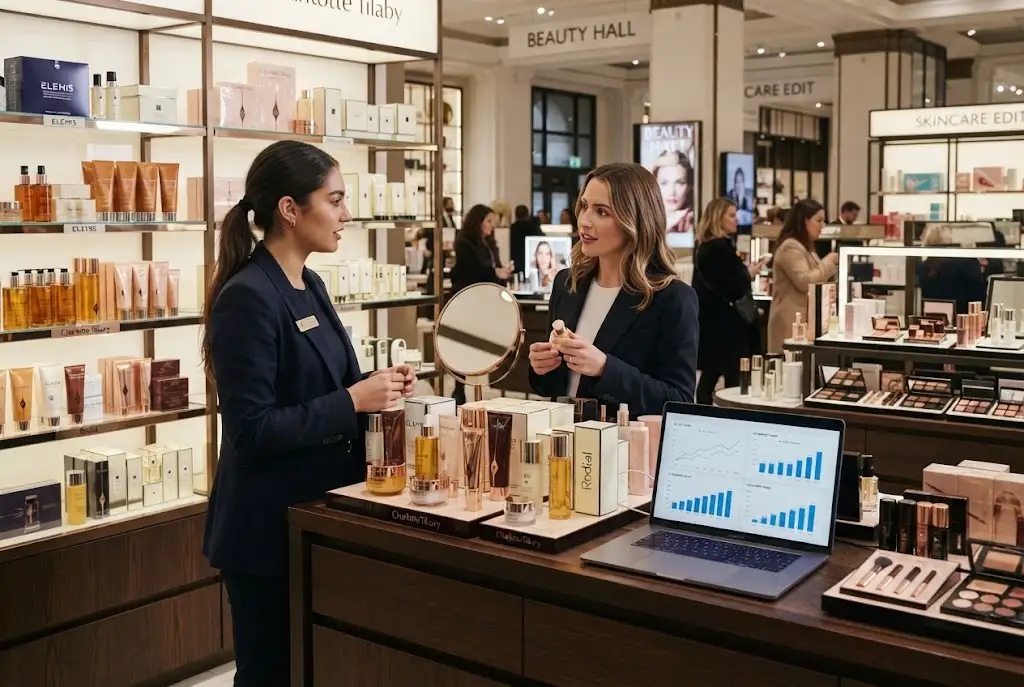
Beauty statistics UK data provides a useful way to understand how the country’s cosmetics, skincare, haircare and personal-care markets are changing. Behind the latest beauty trends are measurable shifts in consumer spending, retail activity, business numbers and product demand. Looking at reliable data can therefore reveal a much clearer picture of beauty in Britain than social media trends alone.
The UK beauty market covers a wide range of activities, from cosmetics manufacturing and retail to salons, hairdressing, skincare and personal-care services. Official statistics also show that beauty is not a single market: different categories and parts of the industry can perform differently at the same time.
Beauty Statistics UK: What the Latest Data Shows
One of the most useful starting points is official UK economic data. The Office for National Statistics published its latest dedicated Beauty industry 2025 dataset in March 2026. It covers the number of VAT and/or PAYE-based enterprises, employment and turnover across specified UK geographies, including businesses classified within the beauty industry and hairdressing and beauty treatment. ([ons.gov.uk](https://www.ons.gov.uk/businessindustryandtrade/business/activitysizeandlocation/adhocs/3304thebeautyindustry2025))
This is important because the size of the beauty industry cannot be measured only by cosmetic product sales. Salons, beauty treatment providers and other businesses also form a significant part of the wider sector.
ONS also publishes dedicated data for hairdressing and beauty salons, allowing the industry to be examined geographically across the UK and within regions and local authorities. ([ons.gov.uk](https://www.ons.gov.uk/businessindustryandtrade/business/activitysizeandlocation/adhocs/3091hairdressingandbeautysalons2025))
UK Beauty Industry Statistics and Business Activity
Business activity is one of the clearest ways to understand the scale of the beauty sector. The ONS beauty industry dataset specifically measures enterprise counts, employment and turnover, providing a broader view than retail sales alone.
The latest dataset also separates the beauty industry geographically. That makes it possible to examine differences between parts of the UK rather than assuming that beauty businesses are distributed evenly across the country.
This matters for businesses because a national market can contain very different local opportunities. A large metropolitan area may support premium salons, specialist aesthetic services and independent beauty businesses, while smaller communities can have stronger demand for established local services.
For consumers, these business statistics help explain why the UK offers such a broad mixture of high-street beauty retailers, independent brands, salons and specialist providers.
Beauty Market Statistics: Personal Care Spending in the UK
Household spending provides another useful indicator of the importance of personal care. ONS national accounts data records current-price household expenditure on personal care.
The latest annual series shows UK household expenditure on personal care at approximately £36.6 billion in 2025, compared with about £37.6 billion in 2024. In current-price terms, that represents a decline of roughly 2.5% between the two years. ([ons.gov.uk](https://www.ons.gov.uk/economy/nationalaccounts/satelliteaccounts/timeseries/adij/ct))
These figures should not be interpreted as a direct measure of the cosmetics market. Personal care is a wider category, so the data can include spending beyond makeup and skincare. Nevertheless, it demonstrates the considerable scale of consumer expenditure associated with personal care in the UK.
It also shows why beauty market statistics need to be interpreted carefully. Different datasets use different definitions, and comparing them without checking their scope can produce misleading conclusions.
Cosmetics Market Statistics in Great Britain
Cosmetics represent another important part of the wider beauty economy. Recent data compiled by the Cosmetic, Toiletry & Perfumery Association and published through Statista tracks the value of the cosmetics market in Great Britain over time.
The data shows that the cosmetics market experienced a downturn during the period around 2017 to 2021 before moving into a recovery phase. The latest series covers market value through 2025. ([statista.com](https://www.statista.com/statistics/289762/market-value-of-cosmetics-in-great-britain/))
This longer-term perspective is useful because a single year’s result does not necessarily explain the direction of the market. Economic conditions, changes in shopping behaviour and differences between product categories can all affect annual results.
Cosmetics market data also shows why the word “beauty” should not be treated as one uniform category. Toiletries, skincare, fragrance, haircare and colour cosmetics can each have different purchasing patterns.
Skincare Statistics and the Growing Importance of Skin Health
Skincare has become one of the most closely watched areas of the beauty market. Current market data tracks skincare separately from other cosmetic categories, making it possible to examine its development over time.
Data covering Great Britain shows that the skincare market has fluctuated over the long term, with the latest available series extending through December 2025. The figures are compiled from data associated with the Cosmetic, Toiletry & Perfumery Association. ([statista.com](https://www.statista.com/statistics/289747/skincare-tota-market-value-in-great-britain/))
The importance of skincare is also visible in consumer behaviour. People increasingly encounter products positioned around hydration, skin barrier support, pigmentation, acne, visible ageing and other specific concerns.
This trend connects closely with beauty research. As consumers become more interested in ingredients and evidence, scientific research can help explain the difference between a popular skincare claim and a claim supported by credible evidence.
Why skincare data needs context
A rise or fall in skincare sales does not necessarily mean that consumers are becoming more or less interested in skincare. Changes in prices, product launches, promotions, retail channels and economic conditions can all influence market value.
For that reason, good analysis should consider multiple indicators rather than relying on a single market figure.
Makeup Statistics and Colour Cosmetics
Makeup remains an important component of the UK beauty market, although its performance can differ from categories such as skincare and toiletries.
Colour cosmetics include products such as foundation, concealer, eye makeup, lipstick and other decorative cosmetics. Market data tracks colour cosmetics separately, allowing analysts to compare its position with other beauty categories.
The broader cosmetics data indicates that category shares can vary considerably. Statista’s latest Great Britain data, sourced from the Cosmetic, Toiletry & Perfumery Association, provides category-level market-share information for 2025. ([statista.com](https://www.statista.com/statistics/289810/cosmetics-market-sector-share-of-category-by-valuein-great-britain/))
Makeup demand can also be particularly sensitive to cultural and social trends. New application techniques, celebrity looks and social media content can quickly influence which products consumers notice.
That makes makeup an interesting example of how beauty trends UK audiences follow can interact with commercial market behaviour.
UK Beauty Data Shows Changes in Retail Activity
Retail sales data provides another perspective on the health of the beauty market. ONS maintains a Retail Sales Index series specifically covering the retail sale of cosmetic and toilet articles.
The volume index reached 115.2 in June 2026 and stood at 114.6 in July 2026, using 2023 as the index reference year of 100. This means the volume of retail activity represented by the series was substantially above its 2023 reference level during those months. ([ons.gov.uk](https://www.ons.gov.uk/businessindustryandtrade/retailindustry/timeseries/jo5m/drsi))
An index should not be confused with pounds spent. A value of 114.6 does not mean that consumers spent £114.60. Instead, it represents the relative level of retail volume against the series’ reference period.
This distinction is important when reading UK beauty data. Market value, retail volume and household expenditure measure different things and should not be treated as interchangeable.
Beauty Industry Facts About UK Salons
Beauty salons form an important part of the UK beauty services economy. They also demonstrate why product-market statistics do not tell the whole story.
ONS published a dedicated 2025 analysis of hairdressing and beauty salons that covers enterprise counts, employment, employees and turnover. The dataset provides geographic detail across the UK, including English regions, counties, London boroughs and other local administrative areas. ([ons.gov.uk](https://www.ons.gov.uk/businessindustryandtrade/business/activitysizeandlocation/adhocs/3091hairdressingandbeautysalons2025))
This geographic approach can be particularly valuable for businesses planning expansion. Beauty services are often local by nature, so national statistics may hide important differences between individual areas.
Local beauty businesses can also contribute to wider employment and entrepreneurship. Independent salons, freelance professionals and specialist treatment providers create a diverse service ecosystem alongside larger chains and established brands.
Beauty Consumer Statistics and Changing Shopping Habits
Consumer behaviour is becoming increasingly fragmented. A beauty shopper might discover a product through TikTok, research its ingredients through a search engine, compare prices online and eventually purchase it from a high-street retailer.
This means traditional retail statistics cannot always explain how consumers discover products.
Social media has also shortened the time between product discovery and demand. A cosmetic technique or product can gain visibility rapidly, although attention does not necessarily translate into sustained purchasing.
Consumers are also becoming more interested in product information. Ingredient lists, sustainability claims, reviews and evidence-based explanations can all influence purchasing decisions.
For brands, this means that consumer education can become as important as conventional advertising.
Beauty Industry Facts: What the Numbers Do Not Tell Us
Statistics are powerful, but they have limitations. A market-value figure cannot explain why a consumer chooses one moisturiser over another. An enterprise count cannot tell us whether every salon is profitable. Retail volume cannot reveal exactly which products are responsible for a change.
Context is therefore essential.
It is also important to distinguish between Great Britain and the United Kingdom. Some commercial datasets are specifically reported for Great Britain, while official ONS datasets may cover the UK. England, Scotland, Wales and Northern Ireland can also show different patterns.
Anyone publishing beauty industry facts should therefore check the geographic scope, time period, methodology and category definition before quoting a statistic.
Why Beauty Statistics Matter for Brands and Businesses
Reliable statistics can help beauty companies make better strategic decisions. Market data can support decisions about product development, pricing, distribution and geographic expansion.
For example, a brand examining skincare statistics may want to understand whether demand is growing, stable or declining before investing heavily in a new product line. A salon may be more interested in local enterprise and employment data than national cosmetics sales.
Market research can also reveal where consumer expectations are changing. Sustainability, ingredient transparency, personalisation and technology are all areas where consumer interest can influence future product development.
These developments are closely related to the wider discussion around sustainable beauty, particularly as consumers consider packaging, waste and responsible purchasing alongside product performance.
How to Use UK Beauty Statistics Responsibly
When using beauty statistics in articles, reports or business plans, it is worth following a few basic principles.
Check the source
Prefer official government statistics, recognised industry bodies and clearly identified research organisations. The ONS is particularly useful for UK business, employment, expenditure and retail data.
Check the date
Beauty markets can change quickly. A statistic from several years ago may still be useful for historical comparison, but it should not be presented as current market information.
Check the definition
Make sure the statistic actually measures what you claim it measures. “Personal care”, “cosmetics”, “skincare” and “beauty services” are not interchangeable categories.
Do not confuse correlation with causation
If two trends occur at the same time, that does not automatically mean one caused the other. Good analysis should distinguish between what the data directly shows and what can reasonably be inferred from it.
What Beauty Statistics UK Data Could Reveal Next
The future of UK beauty will be easier to understand as more detailed data becomes available across products, services, consumer behaviour and technology.
Retail data can show changes in purchasing activity. Business statistics can reveal where beauty enterprises are concentrated. Market research can explain consumer preferences, while scientific research can provide context for new ingredients and cosmetic technologies.
Combining these sources creates a much stronger picture than relying on a single headline statistic.
For consumers, the growing availability of data can make beauty information easier to evaluate. For businesses, it can support more informed decisions about products, services and markets.
Final Thoughts on UK Beauty Data
Beauty statistics UK data shows that Britain’s beauty economy is much broader than makeup and skincare sales. It includes personal-care spending, cosmetic retail, salons, hairdressing, specialist treatments, employment and thousands of businesses operating across different parts of the country.
The latest ONS data provides a valuable foundation for understanding the business and employment side of the sector, while retail and market datasets add insight into consumer purchasing and individual beauty categories. Together, these sources show an industry that continues to evolve.
The most useful beauty statistics are therefore not simply the biggest numbers. They are the figures that have a clear definition, reliable source and appropriate context. By looking beyond viral claims and examining trustworthy UK beauty data, readers and businesses can gain a more realistic understanding of how the beauty industry is changing.