Wheel alignment is an important part of vehicle maintenance, particularly for motorists dealing with London’s busy roads, potholes, speed humps and frequent stop-start traffic. When the wheels are correctly aligned, the vehicle can track properly, steering can feel more consistent and tyres can wear more evenly.
Alignment problems are not always obvious immediately. A car may continue to drive while gradually developing uneven tyre wear, a steering wheel that sits off-centre or a tendency to pull towards one side. Recognising these signs early can help London drivers address problems before they lead to unnecessary tyre replacement or further suspension and steering issues.
What Is Wheel Alignment?
Wheel alignment involves adjusting the angles of the vehicle’s wheels so they meet the manufacturer’s specified geometry. The exact alignment settings vary between vehicles and can involve measurements such as camber, caster and toe.
These angles affect how the tyres contact the road and how the vehicle responds to steering inputs. If alignment moves outside the appropriate range, the car may not behave as intended.
Alignment is different from wheel balancing. Balancing deals primarily with the distribution of weight around a wheel and tyre assembly, while alignment concerns the position and angles of the wheels relative to the vehicle.
Both services can be relevant when a vehicle develops vibration, uneven tyre wear or changes in driving behaviour, but they address different problems.
Why Wheel Alignment Matters on London’s Roads
Urban driving can expose vehicles to a wide range of road conditions. London’s roads include busy junctions, narrow streets, speed cushions, raised crossings, uneven surfaces and potholes. Kerb impacts are also relatively common when parking or navigating tight streets.
A significant impact can affect a wheel, tyre, steering component or suspension part. In some cases, the vehicle may require an inspection before alignment is carried out because an underlying damaged component needs attention first.
That is why an alignment check can be useful after a substantial impact, particularly if the vehicle’s handling changes afterwards.
Signs Your Vehicle May Need Alignment
Drivers often notice changes in handling before they realise that alignment could be involved. Some warning signs are subtle, while others are more obvious.
The Car Pulls to One Side
If the vehicle consistently drifts or pulls towards one side on a suitable road surface, it is worth having the tyres, steering and alignment checked. However, pulling can have several causes, including tyre pressure differences or other mechanical issues, so alignment should not automatically be assumed to be the cause.
The Steering Wheel Is Off-Centre
If the vehicle travels straight but the steering wheel sits noticeably to one side, alignment may need checking. A change following a pothole or kerb impact is particularly worth investigating.
Uneven Tyre Wear
Tyre wear can provide useful clues about how a vehicle is contacting the road. Excessive wear on one edge of a tyre, for example, may indicate an alignment or suspension issue.
The Highway Code advises drivers that excessive or uneven tyre wear can be associated with faults in braking or suspension systems or wheels being out of alignment.
Because uneven wear can have multiple causes, a professional inspection is preferable to simply replacing the tyre without investigating why the wear occurred.
Pothole Damage and Wheel Alignment
Pothole damage is one of the reasons London motorists may eventually need an alignment check. A deep or unexpected pothole can create a substantial impact through the tyre and wheel into the suspension and steering system.
The outcome depends on the severity of the impact and the condition of the vehicle. In some cases, there may be no obvious damage. In others, the driver may notice a change in steering, vibration, tyre pressure or handling.
After a serious pothole strike, do not assume that an alignment adjustment alone will solve the problem. A garage should first check the wheel, tyre, suspension and steering components for signs of damage.
What to Check After a Pothole Impact
- Check whether the tyre has visible cuts, bulges or other damage.
- Check the tyre pressure when safe to do so.
- Pay attention to new steering or handling changes.
- Listen for unusual suspension or wheel noises.
- Look for new or worsening tyre wear.
- Arrange a professional inspection if the impact was severe or the vehicle behaves differently.
Government guidance states that drivers are responsible for ensuring their vehicles are roadworthy and that tyres must have the correct tread depth and be free from cuts and defects.
Wheel Alignment vs Wheel Balancing
Wheel alignment and wheel balancing are often mentioned together, but they solve different problems.
Balancing addresses uneven weight distribution in the wheel and tyre assembly. An imbalance can contribute to vibration, particularly at certain speeds.
Alignment, by contrast, concerns the angles and positioning of the wheels. A vehicle with an alignment problem may show uneven tyre wear, steering irregularities or directional changes.
Sometimes a driver can need both services. For example, a pothole impact could affect the wheel and tyre assembly while also creating a potential alignment or suspension issue. A proper inspection can establish which service is appropriate.
Steering Alignment and Vehicle Stability
Steering alignment is closely connected to how a vehicle responds to the driver’s inputs. When the wheels are not positioned correctly, the vehicle may feel less predictable or require frequent steering corrections.
Vehicle stability depends on many factors, including tyres, suspension, steering components, road conditions and alignment. Therefore, alignment should be viewed as one part of the vehicle’s overall safety and maintenance system rather than a standalone solution for every handling issue.
If a car suddenly begins pulling strongly, develops severe steering problems or experiences a major change after an impact, it should be inspected rather than continuing to drive normally.
How Tyre Wear Can Reveal Alignment Problems
Tyres are one of the most useful visual indicators of vehicle condition. Uneven wear can sometimes indicate that the wheel geometry needs attention.
For example, a tyre that is wearing significantly faster on one edge than the other may justify an alignment inspection. However, tyre pressure, suspension condition, driving habits and tyre quality can also affect wear patterns.
Drivers should therefore avoid treating a single wear pattern as definitive proof of an alignment problem. A technician can inspect the complete vehicle and determine whether the alignment readings are within the manufacturer’s specified range.
UK MOT guidance also covers wheels, tyres and suspension, including tyre condition, pressure-related defects and suspension components.
When Should You Get a Wheel Alignment Check?
There is no universal interval that applies to every vehicle. Some drivers may need alignment attention following an impact, while others may discover an issue during routine tyre maintenance.
An alignment check can be worth considering when:
- The vehicle has struck a significant pothole.
- A wheel has hit a kerb hard.
- New tyres show unusual wear.
- The steering wheel no longer sits straight when travelling normally.
- The vehicle consistently pulls to one side.
- Suspension or steering components have been replaced.
- Handling feels different from before.
After suspension or steering repairs, the alignment may need to be checked because changing components can affect the vehicle’s geometry.
Wheel Alignment and London Traffic
London traffic creates a driving environment where motorists constantly accelerate, brake, turn and manoeuvre through confined spaces. This does not automatically cause alignment problems, but it means drivers regularly interact with kerbs, junctions, speed restrictions and uneven road surfaces.
Parking can also contribute to repeated low-speed kerb contact. Even small impacts may become relevant when they happen frequently, particularly if a vehicle already has worn suspension or steering components.
For drivers who cover many urban miles, paying attention to changes in tyre wear and steering behaviour can therefore be worthwhile.
Choosing a London Garage for Alignment Work
Not every garage approaches alignment work in exactly the same way. When choosing a provider, ask whether the workshop has appropriate alignment equipment and whether technicians can work with the specifications for your particular vehicle.
Established London garage chains may offer alignment services at selected centres, while independent workshops can also provide alignment and related tyre services.
The important factor is whether the garage can accurately measure the vehicle and identify any underlying issue that could affect the results.
Ask What the Alignment Check Covers
Before booking, ask whether the service is a front-wheel alignment or a four-wheel alignment, where appropriate for the vehicle. Also ask whether the technician will provide readings before and after adjustment.
A professional explanation of the results can help you understand whether the vehicle needed only an adjustment or whether another component requires attention.
Wheel Alignment After New Tyres
Fitting new tyres does not automatically mean a vehicle needs an alignment adjustment. However, new tyres can make an existing alignment issue more noticeable, particularly if the previous tyres had developed uneven wear.
If your old tyres show pronounced wear on one edge, it is sensible to investigate the cause before fitting replacement tyres. Otherwise, the new tyres could potentially develop a similar pattern.
Tyre replacement is therefore an opportunity to check the condition of the wheels, steering and suspension rather than simply fitting new rubber and ignoring the previous wear pattern.
Wheel Alignment and EVs in London
Electric vehicles are also affected by wheel alignment and tyre condition. Their electric drivetrains do not remove the need for correctly positioned wheels or healthy suspension components.
As more London motorists adopt electric vehicles, workshops increasingly need to consider alignment alongside the broader requirements of modern vehicle maintenance. Our guide to EV servicing in London covers other maintenance considerations for electric vehicle owners.
For EV drivers, tyre condition can be particularly important because vehicle weight and torque characteristics can influence how tyres are used. Any unusual wear should therefore be investigated rather than ignored.
What Happens During a Wheel Alignment Service?
A technician normally begins by inspecting relevant tyres, wheels, steering and suspension components. If a damaged or excessively worn component is identified, it may need to be repaired before alignment measurements can provide a meaningful result.
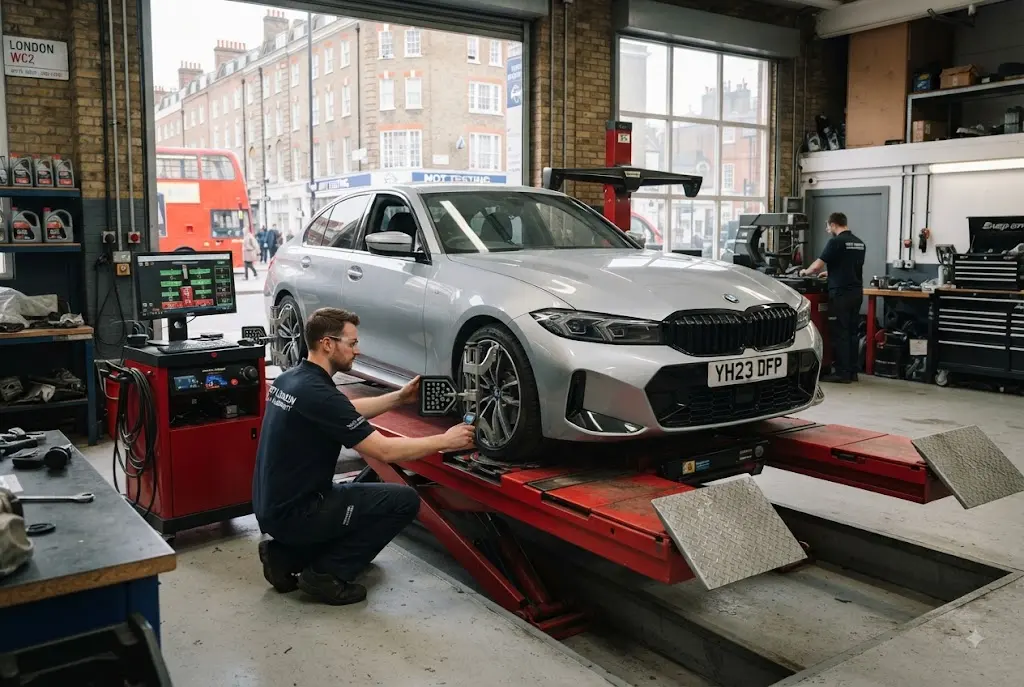
The vehicle is then positioned on suitable alignment equipment, where sensors or measuring systems determine the current wheel angles. The technician compares these measurements with the appropriate specifications and makes adjustments where possible.
The exact process varies according to the vehicle and equipment used. Some vehicles allow adjustment of several alignment angles, while others have more limited adjustment options.
A good service should also identify situations where an alignment problem is actually a symptom of another mechanical issue.
Why Alignment Should Not Be Ignored
Ignoring a significant alignment problem can allow uneven tyre wear to continue. That may shorten tyre life and potentially affect handling.
More importantly, alignment symptoms can sometimes point towards damaged or worn steering and suspension components. Treating only the symptom without identifying the underlying cause may leave the vehicle with an unresolved problem.
Drivers should therefore treat persistent steering changes, abnormal tyre wear and post-impact handling changes as reasons to investigate rather than simply accepting them as normal city driving.
Maintaining Vehicle Stability in Urban Driving
Good vehicle stability depends on several connected systems. Correct tyre pressure, adequate tread, healthy suspension, functioning brakes, suitable wheel alignment and properly maintained steering components all contribute to the vehicle’s behaviour.
Regular visual checks can help identify problems early. GOV.UK advises motorists to check basic vehicle safety and notes that a current MOT does not by itself guarantee that a vehicle remains safe to drive.
For London drivers, that means maintenance should continue between MOT tests. A car can develop a tyre, steering or suspension problem after its annual test, particularly if it experiences an impact.
Final Thoughts on Wheel Alignment in London
Wheel alignment is a relatively straightforward maintenance service, but it can play an important role in keeping a vehicle’s steering, tyre wear and handling in good condition. London’s urban roads can expose vehicles to potholes, kerbs and uneven surfaces, making it sensible to pay attention to changes in how a car drives.
If your vehicle begins pulling to one side, the steering wheel becomes noticeably off-centre or the tyres develop unusual wear, arrange an appropriate inspection. After a significant pothole or kerb impact, checking the tyre, wheel, suspension and steering components can be just as important as checking the alignment itself.
Ultimately, alignment should be considered part of a wider maintenance routine. Combined with correct tyre pressures, regular inspections and timely repairs, it can help London motorists keep their vehicles stable, predictable and better prepared for everyday urban driving.